



THE PROBLEM
We asked ChatGPT when Enhanced CDD is required under the AML/CFT Act. It got it wrong. It missed mandatory requirements, mixed in Australian law, and presented the answer with full confidence. If that answer was relied on, you would be non-compliant.
That's the problem with general LLMs in compliance. The wrong answers look exactly like the right ones. ChatGPT, Copilot, Claude and others answer using general information that isn't fact checked. They don't track changes in law, don't understand legal hierarchy, and lose the nuance that compliance decisions depend on.
UpSkill answers from a knowledge base that we update, based on:
Law and regulations.
Regulatory guidance.
A decade of compliance templates, precedents, and practical experience.
Our understanding of market practice and regulatory expectations.
Your own documents.
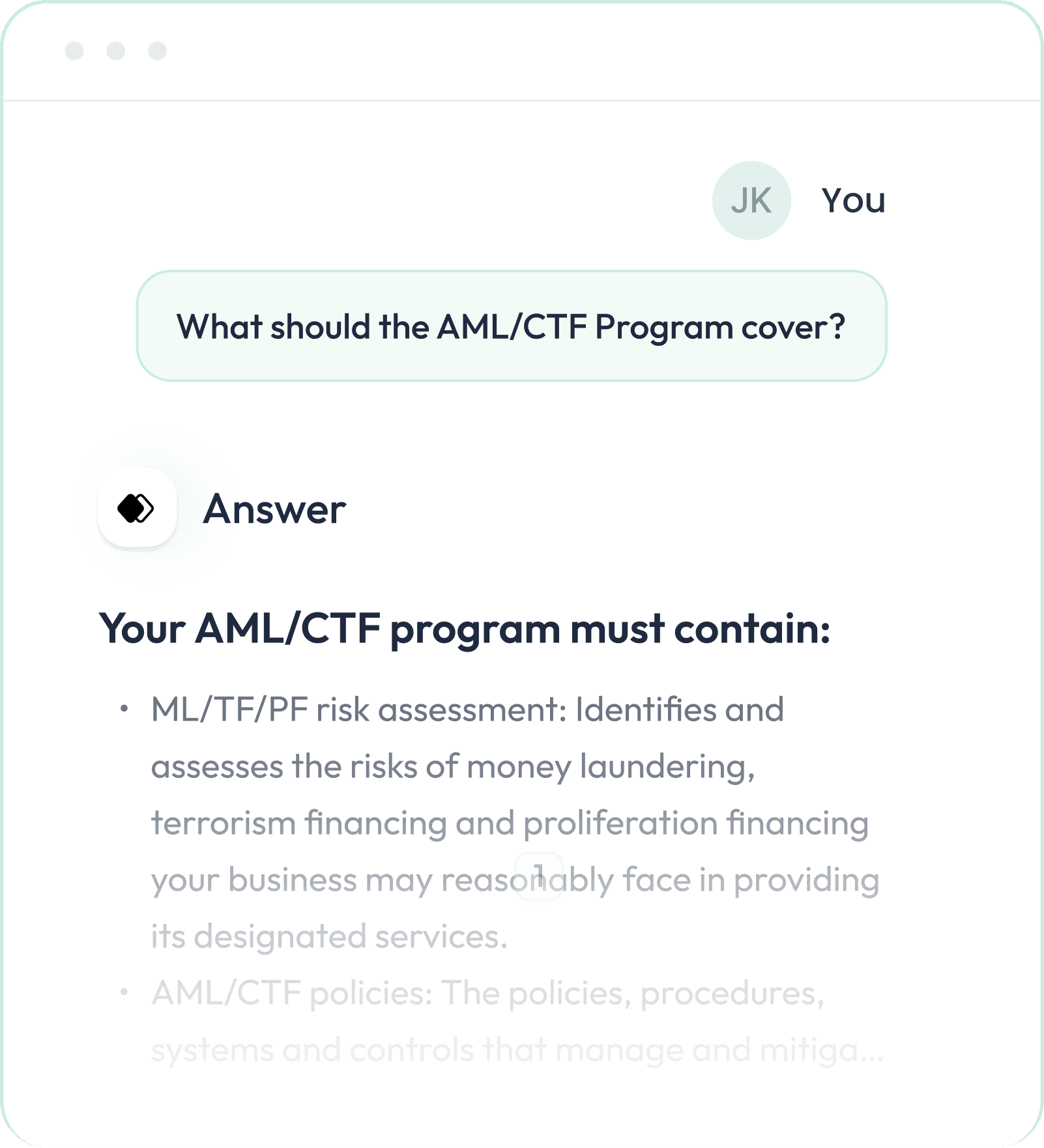
UpSkill keeps these sources separate, so you can see what the law and guidance say, what we say, and what your documents say. Every answer is fact checked, cited to its source, and consistent regardless of who asks it.
1
It doesn't know when it's wrong.
GENERAL LLMS
General models don't know when they're wrong. They give complete, confident answers even when the law or guidance is unclear or outdated or wrong. There is no check. The first answer is the final answer.

UPSKILL
Every answer is checked before you see it. A separate AI layer reviews each response for accuracy. If it doesn't meet the required standard, it won't give you the answer. It flags it to our consultants instead. We run benchmarking tests weekly, and our specialist consultants use and test UpSkill daily to ensure accuracy and reliability.
2
It doesn't know what's current.
GENERAL LLMS
General AI answers from training data that can be months or years out of date. It won't pick up changes to laws or guidance, and it presents old positions as though they are current.
UPSKILL
We track regulatory change. When the Act or Regulations are amended or new guidance is issued, our knowledge base is updated. Answers are based on current law, current guidance, current regulatory views, and current market practice.
3
It has no compliance expertise.
GENERAL LLMS
General models have no access to specialist compliance knowledge, templates, or practical experience. They can only work with what's publicly available, and they can't tell you how an obligation is actually applied in practice.
UPSKILL
UpSkill is built on over a decade of our compliance consulting work. Our templates, precedents, guidance notes, and practical experience are embedded in the knowledge base and maintained by our team of expert consultants. It's like having access to our consultants 24/7.
4
It doesn't give the same answer twice.
GENERAL LLMS
Ask the same question a different way and you get a different answer. Ask it from a different account and you get a different answer. There is no consistency, and no way to know which version is right.
UPSKILL
The same question gets the same answer, from the same sources, no matter how it's asked or who is asking.
5
It doesn't understand legal hierarchy.
GENERAL LLMS
A provision in an Act and an opinion in a blog post are treated as equally reliable. It won't tell you which source is binding, which is explanatory, and which has been replaced.
UPSKILL
UpSkill applies the hierarchy of law. Laws come first. Regulatory guidance is then used to explain and support the legal position. Where there is a conflict between the law and the guidance, UpSkill identifies and highlights it for you.
6
It removes the nuance compliance depends on.
GENERAL LLMS
Must, should, and may carry specific legal meaning. In a general model, those distinctions are blurred or lost. Mandatory obligations and recommended practices end up sounding the same. This can drastically change the regulatory position.
UPSKILL
UpSkill preserves legal accuracy. It distinguishes between what is required, what is recommended, what is best practice, and what you may want to consider.
7
You can't evidence the answer.
GENERAL LLMS
There is no source trail. No citations, no traceable reasoning. If a regulator asks how you reached a conclusion, you have nothing to point to but a chatbot output.
UPSKILL
Every answer comes with citations linked directly to the source material. You can click through to the source material and verify it for yourself.
SEE IT IN PRACTICE
WHAT CHATGPT SAID
Domestic PEP.
Wrong.
International Organisation PEP.
This is Australian law.
Foreign PEPs.
Trusts.
A company acting as a trustee.
Wrong.
High-risk countries.
Suspicious activity.
Correct but wording slightly incorrect.
Other high-risk situations (risk-based trigger).
WHAT IT MISSED
ChatGPT missed some of the following requirements (this
isn't an exhaustive list):
!
!
Customer has nominee shareholders, nominee directors, or shares in bearer form.
!
Customer has a nominee general partner.
!
Customer seeks to conduct a complex, unusually large, or unusual pattern of transactions with no apparent or visible economic or lawful purpose.
!
Customer seeks to use new or developing technologies, or new or developing products, that might favour anonymity.
Why this matters.